One agent for jobs, buyers and investors: why we built it this way
A job search, a sales pipeline and a raise look like three problems. Underneath they're the same work, and doing it in one place, in one voice, is the point.
Istos does three things that don't usually sit together: it finds jobs, it finds buyers, and it finds investors. People sometimes read that as a product that couldn't decide what it was. It's the opposite. It came from doing all three at once, and noticing they were the same job.
Where this started
After two years co-founding and leading Mazerance, I stepped down in September and went back to the job market. At the same time I was still talking to founders about design work, and working on a raise.
So for a few weeks I had three spreadsheets open. Roles I wanted. Founders who might hire me for a project. Investors who backed tools like the one I was starting to build. Three tabs, three sets of notes, three slightly different versions of me writing emails.
The work in each tab was nearly identical:
- Work out who's worth contacting.
- Find out something true about them that makes a note worth sending.
- Write a short note that says who I am, why them, and one thing I'm asking for.
- Remember to follow up, and notice when someone replies.
The tools I found each did one tab. A job tracker for the first, a sales tool for the second, an investor database for the third. Each wanted my resume or my pitch again, my tone again, my sign-off again. None of them knew about the others, so I was the only place where the three lists met.
The same loop, three times
That's the shape of Istos. Three agents, one loop:
- Jobs, Leads, InvestorsEach agent finds and checks its own kind of contact.
- Your knowledgeResume, writing samples, briefs and rules, read by every agent.
- One queueEvery draft, with the reason it was written.
- Your addressApproved messages go out as you.
- The Jobs agent reads the job boards of companies you watch, checks each role against the company's own site, flags likely fakes, scores what's left against your brief and drafts applications from your resume.
- The Leads agent scores buyers against the checks you set, then drafts a first email that sells one thing, with one proof point from your own work.
- The Investors agent looks for funds and angels that fit your raise's stage, sector and region, each with a short note on why, and drafts an introduction that asks for a call.
What they share matters more than what they do separately.
One voice, written down once
Under Settings, Voice and signature holds who you are in one line, the rules the agents must follow (facts to get right, claims never to make), your signature and your booking link. Knowledge holds your resume, writing samples and briefs, with the important ones pinned.
Every agent reads the same rules. If you write "Based in Nairobi, never Lagos" or "Don't mention the old client by name" once, it holds for a cover letter, a sales email and an investor intro alike. You stop correcting the same mistake in three tools.
Some of it is per pipeline on purpose. Lead emails can have their own sign-off and their own offer. Each raise has its own pitch, its own sign-off and its own list of words to avoid, which helps when one raise is sensitive and another isn't.
One queue, one decision
Every draft from every agent lands in the same queue. A job email, a referral ask, a lead email and an investor intro sit side by side, newest first, each with its reason.
That sounds like a small thing. In practice it's what keeps the three from drifting. On a Monday morning you see everything that's about to go out under your name in one list, and you approve, edit or reject it there. Nothing sends until you do.
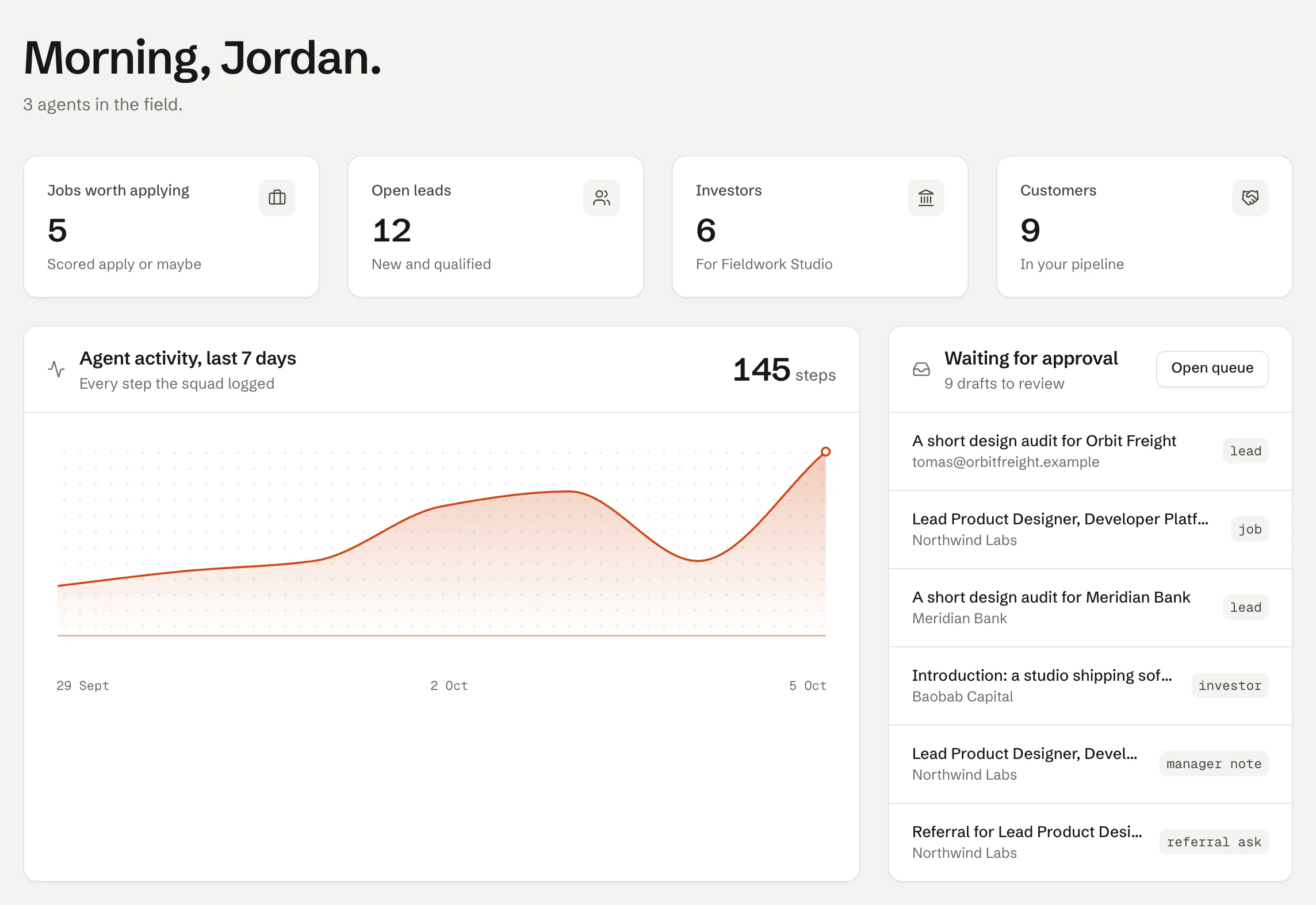
The overview on demo data: three pipelines, one list waiting for approval.
Where the overlap pays off
The reason to keep all three together isn't neatness. It's that they feed each other:
- News. Istos reads the tech press every morning for funding rounds, new offices and hiring. A company that just raised might be hiring, might be buying, and has investors who just wrote a cheque in your space.
- Your network. On Pro, your imported LinkedIn connections show up on the warm path for a role, so you can see who you know at a company before you apply.
- One run budget. Agent runs are the missions you launch. Pro gives you 500 a month across all three pipelines, so a slow week for jobs can be a busy one for leads.
When it's the wrong fit
I'd rather be clear about this than have you find out later.
- If you only want a job, you don't need the other two. Starter runs one pipeline, jobs, leads or investors, and it's free while Istos is in private beta.
- If you want volume, Istos isn't it. It won't send hundreds of applications or emails on its own. Everything waits for you.
- If you need a big contact database, dedicated sales tools are stronger there. Istos works from your own list, your network and the news, not a database of strangers.
- On investors, check the notes. The Investors agent uses web search to find active funds and skips any it can't confirm, but a fund's focus can change faster than its website. Read the note on why each one fits before you approve an intro.
Why one product is cheaper, too
Running three separate tools for this costs real money and real time. Pro is $29 a month for all three pipelines, 500 agent runs, LinkedIn network import and warm-introduction scoring. Studio is $79 a month for three seats working one queue, with Instantly and Apify integrations. Starter is free during the private beta.
But the bigger saving is the one I felt with my three spreadsheets: writing yourself down once, and having every note that goes out sound like the same person. That person is you.
If you're doing more than one of these at once, a job search and a raise, a consultancy and a fundraise, a side project that needs its first customers, that's who Istos is for.
Let the agents do the searching
Istos is in private beta. Join early access, or try the free preview on your resume, your website or your raise first. Nothing sends until you approve it.